Thursday, January 26, 2012
Bridging the Bay 2012 Conference Program Download
Read exciting workshop descriptions and other information about the Bridging the Bay 2012 Conference THIS SATURDAY. Download the Conference Program
Tuesday, January 24, 2012
2012 Bridging the Bay Workshop Descriptions (updated Jan. 24th)
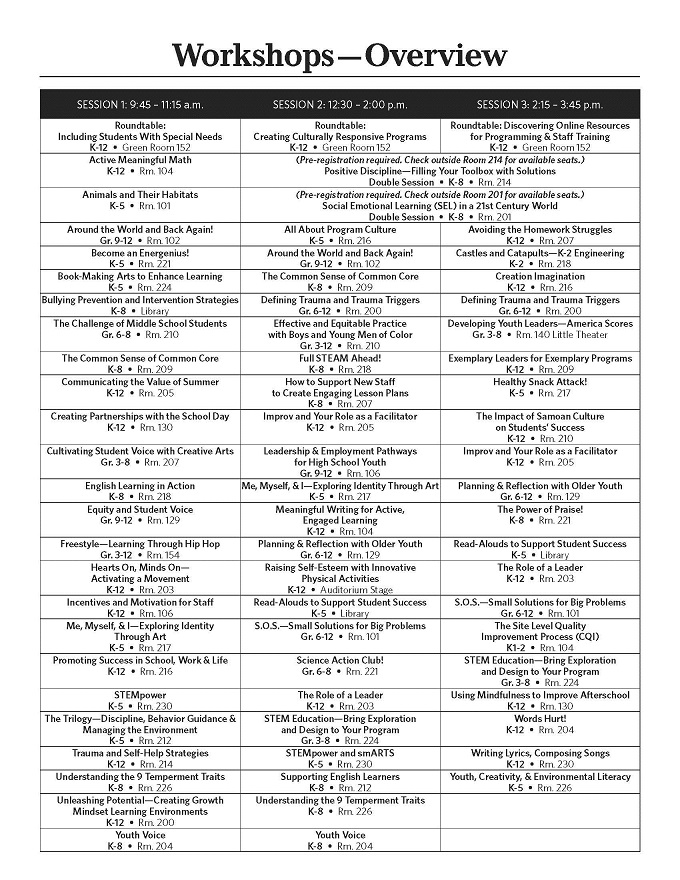
Click on Schedule- WORKSHOPS AT A GLANCE
(ABBREVIATION CODES)
FLS: Front Line Staff
SS: Site Supervisors/Coordinators
DC: District Coordinators
PM: Program Managers
TL: Teacher Liaisons
V: Volunteers Program Managers
TA: Teaching Artists
SP: School Site Principals
CBO: Administrators of Lead Agency/Community Based Organization
Adapting After School Activities for All Learners
Room 256
Alison Stewart & Deidre Hayden, Support for Families
K-12 Recommended for FLS, SS, TL, V
Providing activities that engage all learners is an important part of a high quality after school program. In this session you will learn: what makes some activities more inclusive than others, how to use a tool to help you select and adapt activities for diverse learners, and specific tips and strategies for working with children with disabilities.
Afterschool Science Matters: Developing & Supporting High Quality Science Programming in Out-of-School Time Programs
Room 251
Maria Anaya, Techbridge, Kasey Blackburn, Oakland Afterschool Programs, William Wong, East Bay Asian Youth Center
Gr. 3-8 Recommended for FLS, SS, CBO, PM
How do you support engaging, high quality science and engineering activities with elementary and middle school youth? The Oakland After-School Programs Office and Techbridge will share promising practices for designing and supporting quality science programming in out of school time settings. Participants will walk away with a promising practices guide that outlines practices and strategies to support staff.
Assess and Improve Quality with Free Resources from the California Afterschool Network!
Room 256
Jeff Davis, California Afterschool Network
Gr. K-12 Recommended for SS, CBO, PM, DC, SP
Participants will learn multiple ways to engage staff and stakeholders to increase after school program quality utilizing the California Afterschool Program Quality Assessment (QSA) Tool and Campaign for Quality resources. The Quality Self-Assessment Tool can be utilized by Program Directors and site leaders to identify strengths and areas for potential improvement. Campaign for Quality resources (videos and publications) document promising and successful practices currently in-place in California's after school programs. Participants will receive hard copies of the QSA Tool and Campaign for Quality resources and learn multiple strategies to use these resources for continuous program quality improvement.
Being a Star Makes Reading Fun with Reader's Theater
Room 310
Dianna Cleveland, Playbooks
K-8 Recommended for FLS, SS, TL, V, DC, PM, TA
Laugh while you learn in this interactive session how reader’s theater is simply reading aloud like a play, without memorization, props or a stage and is effective, engaging, sustaining, and measurable. Students love it and your staff will too! Gain hands-on experience implementing reader’s theater directly in the workshop and become fully prepared to apply this practice to your own programs and students.
Bringing Science into Action in Afterschool
Room 308
Courtney Rudd, California Academy of Sciences
Gr. 6-8 Recommended for: FLS, SS, TL, SP
Join a marine biologist/education program manager from the California Academy of Sciences to: 1) Do a quick, fun science activity designed for afterschool programming! 2) Discuss the Science Action Club STEM OST learning program and how you can bring it to your site 3) Panel, brainstorm, and discussion on best practices in STEM OST learning!!
Building a Better Workforce
Room 315
Kathleen White, City College of San Francisco
K-8 Recommended for FLS, SS, CBO, DC, SP, PM
The Quality Standards Sub-committee of the After School for All Advisory Group, sponsored by the Dept. of Children, Youth and their Families in San Francisco has made specific recommendations related to supporting quality improvement efforts of after school workforce. Members the school district, non-profit and community agencies, institutions of higher education and practitioners have developed strategies to address quality improvement on a number of fronts. Learn how the Core Competencies developed by the AFA council will be utilized and how institutions of higher education, employers and community partners are embedding quality improvement in a range of strategic efforts.
Cooking Healthy: Recipe for Success in ASP
Room 361
Debra Mason & Lloyd Mason, Planting Seeds of Health
K-5 Recommended for FLS, SS, V
Participants will make several recipes and share ideas on how to use them in their own programs. You will learn how to incorporate nutrition, math and science into your cooking lessons while providing your students with a healthy snack, exposing them to new foods, and expanding the vocabulary of your English Language Learners!
Cooking up a Mentorship: Nutrition Education for After-School
Room 310
Shamia Sandles, & Malila Becton, Project EAT
K-12 (Cross-age project development) Recommended for FLS, SS, TL, V, CBO, DC, PM
Establishing a mentorship within your program can be beneficial for all: youth mentors, program participants, and even program leaders. Project EAT staff will guide you through a mentorship plan of action that bridges together youth development and nutrition education through cooking. Participants will learn and prepare an easy and nutritious recipe while building on coaching and group management skills.
Coordinating Success
Room 255
Michael Luk, San Francisco USD
K-12 Recommended for SS, CBO, DC, PM, SP
This presentation covers key strategies and principles for managing a successful after school program or any program.
Creating an Inclusive Program
Room 304
Bob Genevro, Calilfornia School Age Consortium (CalSAC)
K-5 Recommended for FLS, SS, V, PM
During this training, participants will discuss the law regarding inclusion as well as the attitude needed to create an inclusive environment in their programs by making reasonable accommodations for children with disabilities.
Every Monday Matters-YOU MATTER!
Room 360
Melody Phillips, Every Monday Matters
K-12 Recommended for FLS, SS, CBO, DC, PM
Every Monday Matters communicates that it is the plain, simple, ordinary individual, either acting alone or together with others, who can change the world. EMM promotes the fact that people have the power to create change. YOU MATTER. This workshop will assist you in creating a YOU MATTER culture within your school and within your students.
Everyday Conflict Resolution
Room 314
Gail Sadalla, Mediation and Training Consultant
K-12 Recommended for All
Whether at home or at school, or with family or friends, conflict is a part of daily life. This interactive workshop will explore the positive value of conflict, review effective communication and problem solving skills and provide an opportunity for participants to practice a simple mediation process leading to win-win resolutions to everyday conflicts.
Focus on Math
Room 351
Presenter TBD, California School Age Consortium (CalSAC)
K-8 Recommended for FLS, SS, TL, SP, DC, PM
During this presentation, participants will learn about the California Content Standards for mathematics and ways in which afterschool programs can support mastery of those standards. Participants will examine how their own programs already address Content Standards, and learn activities to incorporate them into their own programs.
Focus on Science
Room 351
Presenter TBD, California School Age Consortium (CalSAC)
K-5 Recommended for FLS, SS, TL, SP, DC, PM
During this training, participants will learn about the California Content Standards for Science and ways in which afterschool programs can support mastery of those standards. Participants will also gain engaging new activities to bring back to their programs.
Free Online Tools to Spark Creativity
Room 104
Nicole Dalesio, Pleasanton USD
Gr. 5-12 Recommended for FLS, SS, TL, V
Learn from a Google-Certified teacher how to integrate creativity into all subject areas by mixing and matching free photo, paint, audio, and video tools for digital storytelling and other media-rich curriculum projects for "kids of all ages.”
From Projects to Project Based Learning: Using PBL in Afterschool Programs
Room 301
Thom Markham, Global Redesigns
Gr. 6-12 Recommended for FLS, SS, DC, PM, TL
Learn how to work with afterschool students to help them design powerful, engaging, authentic projects that teach 21st century skills, address community issues, and encourage a student voice in education. Drawing upon the experience of Philadelphia’s highly regarded Out of School Time projects, participants will leave with the key tools and core methods for successful PBL.
Getting Things Done—Working Smarter, Not Harder!
Room 305
Michael Andolina, Jamestown Community Center
Gr. K-12 Recommended for All
You work after-school and every day, you see the same old stuff: frazzled, exhausted, and busy co-workers with too much work and not enough time. You hear people say, “Well, that’s just what it means to work in after-school program right?” Wrong! Become the star staff person who gets things done through tools to better manage your projects and tasks, by communicating clear expectations to your supervisor, and with an honest self-assessment of what really keeps you from getting things done. You’ll leave the workshop with sample work plans, strategies for overcoming barriers to success, and the confidence to go from good to great!
Go Girls! Promoting Social-Emotional Learning Through the Arts
Room 303
Lynn Johnson, Celia Cody-Carrese, Shara Finerman, Glitter & Razz Productions
Gr. K-7 Recommended for FLS, SS, DC, PM, TA, SP, CBO
Go Girls! is a theater and expressive arts program that helps girls strengthen self-love, build positive relationships, and confront bullying. In this workshop, you will learn about the social/emotional life of girls and experience activities that you can use with your girls. You will also learn how Go Girls! works in an Oakland public school to help improve the overall school climate.
Guides on the Side: Preparing Staff to Facilitate Youth-Led Project-Based Learning
Room 301
Jhumpa Bhattacharya & Jimena Quiroga Hopkins, Development Without Limits West
Gr. 3-12 Recommended for FLS, SS, DC, CBO, PM
Quality afterschool programs engage young people by successfully balancing youth development and academic support. By designing programs that are youth-led, and take a project-based learning approach, staff can play the role of facilitator, coach and guide, letting young people take the lead. Come learn the basics of youth-led, project-based learning, and explore how this approach uses the Learning in After School Principles.
Hands-on Science Activities for the Non-Scientist
Room 363
Shannon Eaves, North Beach/Chinatown Beacon Center
Gr. 6-8 Recommended for FLS, SS, V
This workshop is for anyone who is interested in creating a science club in their after school program, but does not have a science background. This workshop provides tips on how to run a successful science club in an afterschool program. Upon completing this session, participants will have learned how to teach 3 different hands-on science activities for middle school students.
Homework Assistance
Room 315
Alice Kuo, California School-Age Consortium CalSAC)
K-8 Recommended for FLS, SS, V
During this training, participants will learn how to be more effective during homework assistance. You will learn to ask probing questions that encourage children/youth to think and problem-solve on their own.
How Kids Learn: A Framework to Promote Quality of Learning in Afterschool
Room 303
Lynn Johnson, Temescal Associates
K-12 Recommended for All
The Learning in Afterschool project is promoting five key learning principles that focus on how children learn best. Hear about the new research supporting these principles. Participants will learn in a hands-on way how to apply these principles to their own programs. A program tool, The Best of Both Worlds, is focused on project-based learning and will be used to help program leaders apply these learning concepts.
How to Think Like a Scientist
Room 253
Michelle Korenstein Schorr & Sandra Takei-Lee, Community Resources for Science (CRS)
K-12 Recommended for FLS, SS, TL, V
With demonstrations and hands-on practice, this workshop explores testing liquids for ph (and what that means!), and doing color separations with paper chromatography. Presentation handouts will include activity directions, supply/material lists, and suggested extensions and alternatives. Information about longer term experiment activities will also be provided. Those attending will have an opportunity to test out the activities during the workshop.
Improving Attendance in Your High School Program
Room 358
Michele Hamilton, Program Manager, Oakland Unified School District
Gr.9-12 Recommended for FLS, SS, SP, DC, CBO, PM, TL
Youth involvement at every stage of successful youth-driven programming impacts attendance. Along with specific strategies for meeting youth needs and boosting attendance, we'll explore some core elements of successful programming: Transitions, Opening and Closing Rituals, Agendas / Lesson Plans, Learning Targets, and Assessments. Participants will learn how to implement these elements in their programs through interactive dialogue, activities, strategies and methodologies.
Improvisation and Beach Ball Literacy
Room 220 (Fitness Lab)
Lisa Safran, Improv Consultants
K-5 Recommended for FLS, SS, TL, V, TA, PM
We will use improvisation and beach balls to enhance and build literacy skills. The games presented in this workshop support teachers in helping students build language skills in a fun and creative way resulting in students developing enhanced listening skills and having more confidence and skill in speaking, reading, and writing. Workshop will be a simulation with 100% interaction.
Including Physical Activity & Nutrition in Afterschool Programs
Room 104
Janice Chin, California Afterschool Resources Center (CASRC)
K-12 Recommended for FLS, SS, DC, PM, TL, V
Join us to complete two 30-minute, free online trainings! Assess the physical ability of your students to enhance inclusion options in physical activities through the “Physical Activity: Ability Awareness” online training. Also, learn how to develop and present a successful and nutritious cooking activity in your afterschool program with the “Cook with Kids” online training. An overview of CASRC’s comprehensive Web site and its free, high-quality resources in every area of afterschool programming will also be covered! Participants will have the opportunity to earn a certificate for successfully passing the online quiz in each online training module.
Inspire a Future Engineer! Exploring Careers through Everyday Science and Engineering Activities
Room 251
Matt Hurley & Lulu McCourt, Techbridge
Gr. 3-10 Recommended for FLS, SS, TL, V, PM
We know providing youth an opportunity to explore and learn about careers is vital but finding the time and resources to make that happen can be challenging. Techbridge will provide engaging strategies to integrate careers into science and engineering activities and sample activities that highlight careers. Participants will engage in hands-on activities that highlight different engineering careers and brainstorm strategies for an upcoming science and engineering activity that YOU can do in your programs.
Managing the Environment, Guiding Behavior, Utilizing Discipline
Room 250
CynDee Zandes, Consult 4 Kids
Gr. K-8 Recommended for FLS, SS, PM
Creating learning environments afterschool requires frontline staff to have classroom management strategies and the support of a Site Supervisor and a program-wide discipline system. Learn how to help youth make positive behavior choices during program. Learn practical strategies that are easy to implement and get results, including how to talk with parents and guardians.
Positive Discipline
Room 253
Lori Onderwyzer, Positive Discipline Associates
K-8 Recommended for All
Positive discipline is discipline that TEACHES. Learn to successfully implement effective strategies that enhance cooperation, responsibility and self-discipline. We will focus on “why children do what they do” and the five criteria for effective discipline. You will have an opportunity to practice tools that you can begin using right away.
Qualities of Thought: Critical Thinking, Question Posing and Social Justice in Spoken Word
Room 252
Aurora King & Freddie Gutierrez, Performing Arts Workshop
Gr. 6-12 Recommended for All
What is critical thinking? Why is it important, and how do the arts help foster its development? In this workshop, participants will learn how the creative process develops critical thinking skills through the art of Spoken Word. This participatory session will engage attendees in finding ways to use social justice and question-posing to drive social content and youth engagement.
Quick Steps to Developing a High-Quality Summer Program
Room 204
Jennifer Hicks and Katie Brackenridge, Partnership for Children and Youth
K-12 Recommended for SS, DC, PM, SP, CBO
Summer planning starts now! Carefully planned summer learning programs can give youth life-changing experiences. In this workshop, you will explore several key steps to designing a quality summer program, including setting goals, hiring staff, planning curriculum, finding the right partners. You will leave this workshop with resources and information on how to put a high-quality summer learning program together quickly.
Setting and Upholding Rules and Expectations
Room 353
Eva Meyers, Educational Consultant
K-8 Recommended for FLS, SS, V, TA
This workshop is designed to help you set rules and expectations for and with your students. We will cover how to help students follow the rules and how to handle students who have trouble following. We will also address strategies for dealing with specific problematic behaviors, including power struggles
Soccer and Literacy: Exercise for Your Mind and Body
Fitness Lab Rm. 220
Yuri Morales, America SCORES Bay Area
K-5 Recommended for FLS, SS, DC, PM
This interactive session will provide an introduction to the America SCORES soccer and literacy program that targets urban elementary school students. You will learn more about the work we do, participate in fun and engaging physical activity and soccer games, and be inspired to think critically and write creatively. Please wear tennis shoes and bring your thinking cap!
STEM Service Learning Part 1- Introduction
Room 360
Nate Ivy, ACOE STEM/Service Learning Coordinator
Gr. 9-12 Recommended for SS, TL, FLS, PM, V, SP
Introduction – Part 1: California’s STEM Service-Learning initiative is designed to engage traditionally under represented youth in STEM (Science, Technology, Engineering and Math) projects that solve real problems in the community. Participants will learn how to engage youth in service-learning projects that use the EPICS (Engineering Projects in Community Service-Learning) design model developed by Purdue University. This workshop will share many examples from Bay Area schools showcasing existing environmental STEM service-learning projects to inspire your efforts. Middle School staff are welcome to attend this session.
STEM Service Learning Part 2 – Applications
Room 360
Nate Ivy, ACOE STEM/Service Learning Coordinator
Gr. 9-12 Recommended for SS, TL, FLS, PM, V, SP
Part 2: Participants from the STEM Service-Learning Part 1 Introduction session are invited to participate in facilitated STEM Service-Learning project planning time. Staff from the Alameda County Office of Education’s STEM Service-Learning initiative and local environmental non-profit organizations will guide EPICS planning, help answer questions, connect you with resources, and troubleshoot initial project plans for a spectacular spring STEMester of Service!
Storytelling with Streetside Stories
Room 255
Chrissy Anderson-Zavala and Luise Leija, Streetside Stories
Gr. K-8 Recommended for FLS, SS, PM, DC, TL, TA
Storytelling, theater, media and visual arts are all powerful tools to build literacy. This dynamic hands-on workshop provides tools and curriculum that are designed to engage and excite youth in writing. Participants will gain tools to use storytelling to teach narrative writing and reinforce school day standards.
Student Tech Support and Leadership with MOUSE Squad
Room 308
Jan Half & Iris Clyne, MOUSE Squad of California
Gr. 4-12 Recommended for All
Engage with MOUSE Squad Student Tech Leadership and learn how you can incorporate tech support in your community. MOUSE Squad students (grades 4-12) will demonstrate how they fix computers, teach tech skills, and create valuable resources for their communities. Attendees will participate in student-led STEM activities (Science, Technology, Engineering & Math) such as “Computer In a Box.” Workshop participants will also engage in activities from online curriculum modules and hear about community collaborations.
Supporting English Learners
Room 256
Marco Chavez, San Mateo County Office of Education
K-12 Recommended for FLS, SS, PM, TL, TA, V
Through student engagement strategies, participants will be provided with tools that support the development of literacy of English Learners, understand research findings and recommendations on ELs, and practice fluency and comprehension strategies.
Using the New California State Physical Activity Guidelines for Afterschool
Girls’ Gym Rm. 218
Lauren Squaglia & Craig McKinley, Project EAT
K-12 Recommended for FLS, SS, PM, TL, V
Come join us for a fun and interactive session in which you will learn about the California State After-School Physical Activity Guidelines. Get hands-on experience with lessons and games you can use immediately with your students, and try out new outdoor management techniques to help your classes run smoothly. Please wear tennis shoes and clothes you can move in. Come ready to be active and have fun!
Virtual Vacation!
Room 303
Lynn Johnson, Temescal Associates
K-7 Recommended for FLS, SS, DC, PM
This workshop will provide program leaders with a proven framework of how to design Virtual Vacations for your youth. Virtual Vacations enhance global awareness and learning by applying an integrated, multi-disciplinary (art, music, culinary arts, science activities, and other disciplines) approach to the study and experience of another country and culture. Virtual Vacation was developed by a New Orleans afterschool program serving children in low-income housing.
What You Should Know About the College Entrance Exams (SAT and ACT)
Room 314
Ben Yarin, Study Smart Tutors
Gr. 9-12 Recommended for FLS, SS, PM, DC, TL, V
This workshop helps after school program staff understand how their high school students should prepare to succeed on the SAT and ACT. We will discuss motivating students by connecting the SAT to their futures. We will outline test prep plans specific to underserved students at each grade level and demystify this intimidating test!
Working With English Learners
Room 250
CynDee Zandes, Consult 4 Kids
Gr. K-8 Recommended for FLS, SS
Are you interested in learning more about how to work with English Learners? This work shop is for you. Overview information about English Learner levels and strategies for supporting the development of language (including academic language, building background knowledge, and frontloading) at each level.
Product Demonstrations:
Afterschool and Technology: Building Success in a Beyond-the-Bell Environment
Room 358
Robin Duncan, Peoples Education
Gr. K-12 Recommended for FLS, SS, PM, SP, TL, V
How do you get kids to focus on academics in the unique weekday world of 3-6pm, when they are already mentally spent and physically ready for anything but a school desk? Measuring Up Live is the answer! This is a web-based program that provides students the opportunity to build academic success in an engaging and motivating way. Better yet, once the student is in the program, the self-leveling feature makes the entire experience unique to the individual. And every time students log on, the program is capturing student performance data that is easily accessible to site supervisors, program managers, and front-line staff (and can be shared with classroom teachers as well) in order to make informed decisions about each student’s learning path.
Experiencing Positive Behavior Through Play
Room 308
John O’Neill, Gamewhys
Gr. 3-12 Recommended for FLS, SS, SP, DC, PM
A PLAYshop designed to offer, and demonstrate the use of game as a highly effective way of introducing children to meaningful lessons and insights on life, within the safety of play, where values are experienced deeply because they are not told by another, but discovered personally. This presentation covers stewarding the Earth, alleviating inequality and overcoming prejudice peacefully. (NOTE: A PLAYshop is a stand-alone program of 4 or 6 games with director manual, designed for teachers of after school programs. Assistance is available to teachers at the onset of using the program over Skype).
Pacha’s Pajamas
Room 204
Aaron Ableman, Balance Edutainment
Grades K-5 Recommended for FLS, SS, TA, TL, V
Pacha’s Pajamas is a story about nature, about the power of music, and about unity. Learn fun and meaningful ways to use the book and CD to inspire awareness and caring for our environment and for all living beings while building language and science vocabulary and concepts.
(ABBREVIATION CODES)
FLS: Front Line Staff
SS: Site Supervisors/Coordinators
DC: District Coordinators
PM: Program Managers
TL: Teacher Liaisons
V: Volunteers Program Managers
TA: Teaching Artists
SP: School Site Principals
CBO: Administrators of Lead Agency/Community Based Organization
Adapting After School Activities for All Learners
Room 256
Alison Stewart & Deidre Hayden, Support for Families
K-12 Recommended for FLS, SS, TL, V
Providing activities that engage all learners is an important part of a high quality after school program. In this session you will learn: what makes some activities more inclusive than others, how to use a tool to help you select and adapt activities for diverse learners, and specific tips and strategies for working with children with disabilities.
Afterschool Science Matters: Developing & Supporting High Quality Science Programming in Out-of-School Time Programs
Room 251
Maria Anaya, Techbridge, Kasey Blackburn, Oakland Afterschool Programs, William Wong, East Bay Asian Youth Center
Gr. 3-8 Recommended for FLS, SS, CBO, PM
How do you support engaging, high quality science and engineering activities with elementary and middle school youth? The Oakland After-School Programs Office and Techbridge will share promising practices for designing and supporting quality science programming in out of school time settings. Participants will walk away with a promising practices guide that outlines practices and strategies to support staff.
Assess and Improve Quality with Free Resources from the California Afterschool Network!
Room 256
Jeff Davis, California Afterschool Network
Gr. K-12 Recommended for SS, CBO, PM, DC, SP
Participants will learn multiple ways to engage staff and stakeholders to increase after school program quality utilizing the California Afterschool Program Quality Assessment (QSA) Tool and Campaign for Quality resources. The Quality Self-Assessment Tool can be utilized by Program Directors and site leaders to identify strengths and areas for potential improvement. Campaign for Quality resources (videos and publications) document promising and successful practices currently in-place in California's after school programs. Participants will receive hard copies of the QSA Tool and Campaign for Quality resources and learn multiple strategies to use these resources for continuous program quality improvement.
Being a Star Makes Reading Fun with Reader's Theater
Room 310
Dianna Cleveland, Playbooks
K-8 Recommended for FLS, SS, TL, V, DC, PM, TA
Laugh while you learn in this interactive session how reader’s theater is simply reading aloud like a play, without memorization, props or a stage and is effective, engaging, sustaining, and measurable. Students love it and your staff will too! Gain hands-on experience implementing reader’s theater directly in the workshop and become fully prepared to apply this practice to your own programs and students.
Bringing Science into Action in Afterschool
Room 308
Courtney Rudd, California Academy of Sciences
Gr. 6-8 Recommended for: FLS, SS, TL, SP
Join a marine biologist/education program manager from the California Academy of Sciences to: 1) Do a quick, fun science activity designed for afterschool programming! 2) Discuss the Science Action Club STEM OST learning program and how you can bring it to your site 3) Panel, brainstorm, and discussion on best practices in STEM OST learning!!
Building a Better Workforce
Room 315
Kathleen White, City College of San Francisco
K-8 Recommended for FLS, SS, CBO, DC, SP, PM
The Quality Standards Sub-committee of the After School for All Advisory Group, sponsored by the Dept. of Children, Youth and their Families in San Francisco has made specific recommendations related to supporting quality improvement efforts of after school workforce. Members the school district, non-profit and community agencies, institutions of higher education and practitioners have developed strategies to address quality improvement on a number of fronts. Learn how the Core Competencies developed by the AFA council will be utilized and how institutions of higher education, employers and community partners are embedding quality improvement in a range of strategic efforts.
Cooking Healthy: Recipe for Success in ASP
Room 361
Debra Mason & Lloyd Mason, Planting Seeds of Health
K-5 Recommended for FLS, SS, V
Participants will make several recipes and share ideas on how to use them in their own programs. You will learn how to incorporate nutrition, math and science into your cooking lessons while providing your students with a healthy snack, exposing them to new foods, and expanding the vocabulary of your English Language Learners!
Cooking up a Mentorship: Nutrition Education for After-School
Room 310
Shamia Sandles, & Malila Becton, Project EAT
K-12 (Cross-age project development) Recommended for FLS, SS, TL, V, CBO, DC, PM
Establishing a mentorship within your program can be beneficial for all: youth mentors, program participants, and even program leaders. Project EAT staff will guide you through a mentorship plan of action that bridges together youth development and nutrition education through cooking. Participants will learn and prepare an easy and nutritious recipe while building on coaching and group management skills.
Coordinating Success
Room 255
Michael Luk, San Francisco USD
K-12 Recommended for SS, CBO, DC, PM, SP
This presentation covers key strategies and principles for managing a successful after school program or any program.
Creating an Inclusive Program
Room 304
Bob Genevro, Calilfornia School Age Consortium (CalSAC)
K-5 Recommended for FLS, SS, V, PM
During this training, participants will discuss the law regarding inclusion as well as the attitude needed to create an inclusive environment in their programs by making reasonable accommodations for children with disabilities.
Every Monday Matters-YOU MATTER!
Room 360
Melody Phillips, Every Monday Matters
K-12 Recommended for FLS, SS, CBO, DC, PM
Every Monday Matters communicates that it is the plain, simple, ordinary individual, either acting alone or together with others, who can change the world. EMM promotes the fact that people have the power to create change. YOU MATTER. This workshop will assist you in creating a YOU MATTER culture within your school and within your students.
Everyday Conflict Resolution
Room 314
Gail Sadalla, Mediation and Training Consultant
K-12 Recommended for All
Whether at home or at school, or with family or friends, conflict is a part of daily life. This interactive workshop will explore the positive value of conflict, review effective communication and problem solving skills and provide an opportunity for participants to practice a simple mediation process leading to win-win resolutions to everyday conflicts.
Focus on Math
Room 351
Presenter TBD, California School Age Consortium (CalSAC)
K-8 Recommended for FLS, SS, TL, SP, DC, PM
During this presentation, participants will learn about the California Content Standards for mathematics and ways in which afterschool programs can support mastery of those standards. Participants will examine how their own programs already address Content Standards, and learn activities to incorporate them into their own programs.
Focus on Science
Room 351
Presenter TBD, California School Age Consortium (CalSAC)
K-5 Recommended for FLS, SS, TL, SP, DC, PM
During this training, participants will learn about the California Content Standards for Science and ways in which afterschool programs can support mastery of those standards. Participants will also gain engaging new activities to bring back to their programs.
Free Online Tools to Spark Creativity
Room 104
Nicole Dalesio, Pleasanton USD
Gr. 5-12 Recommended for FLS, SS, TL, V
Learn from a Google-Certified teacher how to integrate creativity into all subject areas by mixing and matching free photo, paint, audio, and video tools for digital storytelling and other media-rich curriculum projects for "kids of all ages.”
From Projects to Project Based Learning: Using PBL in Afterschool Programs
Room 301
Thom Markham, Global Redesigns
Gr. 6-12 Recommended for FLS, SS, DC, PM, TL
Learn how to work with afterschool students to help them design powerful, engaging, authentic projects that teach 21st century skills, address community issues, and encourage a student voice in education. Drawing upon the experience of Philadelphia’s highly regarded Out of School Time projects, participants will leave with the key tools and core methods for successful PBL.
Getting Things Done—Working Smarter, Not Harder!
Room 305
Michael Andolina, Jamestown Community Center
Gr. K-12 Recommended for All
You work after-school and every day, you see the same old stuff: frazzled, exhausted, and busy co-workers with too much work and not enough time. You hear people say, “Well, that’s just what it means to work in after-school program right?” Wrong! Become the star staff person who gets things done through tools to better manage your projects and tasks, by communicating clear expectations to your supervisor, and with an honest self-assessment of what really keeps you from getting things done. You’ll leave the workshop with sample work plans, strategies for overcoming barriers to success, and the confidence to go from good to great!
Go Girls! Promoting Social-Emotional Learning Through the Arts
Room 303
Lynn Johnson, Celia Cody-Carrese, Shara Finerman, Glitter & Razz Productions
Gr. K-7 Recommended for FLS, SS, DC, PM, TA, SP, CBO
Go Girls! is a theater and expressive arts program that helps girls strengthen self-love, build positive relationships, and confront bullying. In this workshop, you will learn about the social/emotional life of girls and experience activities that you can use with your girls. You will also learn how Go Girls! works in an Oakland public school to help improve the overall school climate.
Guides on the Side: Preparing Staff to Facilitate Youth-Led Project-Based Learning
Room 301
Jhumpa Bhattacharya & Jimena Quiroga Hopkins, Development Without Limits West
Gr. 3-12 Recommended for FLS, SS, DC, CBO, PM
Quality afterschool programs engage young people by successfully balancing youth development and academic support. By designing programs that are youth-led, and take a project-based learning approach, staff can play the role of facilitator, coach and guide, letting young people take the lead. Come learn the basics of youth-led, project-based learning, and explore how this approach uses the Learning in After School Principles.
Hands-on Science Activities for the Non-Scientist
Room 363
Shannon Eaves, North Beach/Chinatown Beacon Center
Gr. 6-8 Recommended for FLS, SS, V
This workshop is for anyone who is interested in creating a science club in their after school program, but does not have a science background. This workshop provides tips on how to run a successful science club in an afterschool program. Upon completing this session, participants will have learned how to teach 3 different hands-on science activities for middle school students.
Homework Assistance
Room 315
Alice Kuo, California School-Age Consortium CalSAC)
K-8 Recommended for FLS, SS, V
During this training, participants will learn how to be more effective during homework assistance. You will learn to ask probing questions that encourage children/youth to think and problem-solve on their own.
How Kids Learn: A Framework to Promote Quality of Learning in Afterschool
Room 303
Lynn Johnson, Temescal Associates
K-12 Recommended for All
The Learning in Afterschool project is promoting five key learning principles that focus on how children learn best. Hear about the new research supporting these principles. Participants will learn in a hands-on way how to apply these principles to their own programs. A program tool, The Best of Both Worlds, is focused on project-based learning and will be used to help program leaders apply these learning concepts.
How to Think Like a Scientist
Room 253
Michelle Korenstein Schorr & Sandra Takei-Lee, Community Resources for Science (CRS)
K-12 Recommended for FLS, SS, TL, V
With demonstrations and hands-on practice, this workshop explores testing liquids for ph (and what that means!), and doing color separations with paper chromatography. Presentation handouts will include activity directions, supply/material lists, and suggested extensions and alternatives. Information about longer term experiment activities will also be provided. Those attending will have an opportunity to test out the activities during the workshop.
Improving Attendance in Your High School Program
Room 358
Michele Hamilton, Program Manager, Oakland Unified School District
Gr.9-12 Recommended for FLS, SS, SP, DC, CBO, PM, TL
Youth involvement at every stage of successful youth-driven programming impacts attendance. Along with specific strategies for meeting youth needs and boosting attendance, we'll explore some core elements of successful programming: Transitions, Opening and Closing Rituals, Agendas / Lesson Plans, Learning Targets, and Assessments. Participants will learn how to implement these elements in their programs through interactive dialogue, activities, strategies and methodologies.
Improvisation and Beach Ball Literacy
Room 220 (Fitness Lab)
Lisa Safran, Improv Consultants
K-5 Recommended for FLS, SS, TL, V, TA, PM
We will use improvisation and beach balls to enhance and build literacy skills. The games presented in this workshop support teachers in helping students build language skills in a fun and creative way resulting in students developing enhanced listening skills and having more confidence and skill in speaking, reading, and writing. Workshop will be a simulation with 100% interaction.
Including Physical Activity & Nutrition in Afterschool Programs
Room 104
Janice Chin, California Afterschool Resources Center (CASRC)
K-12 Recommended for FLS, SS, DC, PM, TL, V
Join us to complete two 30-minute, free online trainings! Assess the physical ability of your students to enhance inclusion options in physical activities through the “Physical Activity: Ability Awareness” online training. Also, learn how to develop and present a successful and nutritious cooking activity in your afterschool program with the “Cook with Kids” online training. An overview of CASRC’s comprehensive Web site and its free, high-quality resources in every area of afterschool programming will also be covered! Participants will have the opportunity to earn a certificate for successfully passing the online quiz in each online training module.
Inspire a Future Engineer! Exploring Careers through Everyday Science and Engineering Activities
Room 251
Matt Hurley & Lulu McCourt, Techbridge
Gr. 3-10 Recommended for FLS, SS, TL, V, PM
We know providing youth an opportunity to explore and learn about careers is vital but finding the time and resources to make that happen can be challenging. Techbridge will provide engaging strategies to integrate careers into science and engineering activities and sample activities that highlight careers. Participants will engage in hands-on activities that highlight different engineering careers and brainstorm strategies for an upcoming science and engineering activity that YOU can do in your programs.
Managing the Environment, Guiding Behavior, Utilizing Discipline
Room 250
CynDee Zandes, Consult 4 Kids
Gr. K-8 Recommended for FLS, SS, PM
Creating learning environments afterschool requires frontline staff to have classroom management strategies and the support of a Site Supervisor and a program-wide discipline system. Learn how to help youth make positive behavior choices during program. Learn practical strategies that are easy to implement and get results, including how to talk with parents and guardians.
Positive Discipline
Room 253
Lori Onderwyzer, Positive Discipline Associates
K-8 Recommended for All
Positive discipline is discipline that TEACHES. Learn to successfully implement effective strategies that enhance cooperation, responsibility and self-discipline. We will focus on “why children do what they do” and the five criteria for effective discipline. You will have an opportunity to practice tools that you can begin using right away.
Qualities of Thought: Critical Thinking, Question Posing and Social Justice in Spoken Word
Room 252
Aurora King & Freddie Gutierrez, Performing Arts Workshop
Gr. 6-12 Recommended for All
What is critical thinking? Why is it important, and how do the arts help foster its development? In this workshop, participants will learn how the creative process develops critical thinking skills through the art of Spoken Word. This participatory session will engage attendees in finding ways to use social justice and question-posing to drive social content and youth engagement.
Quick Steps to Developing a High-Quality Summer Program
Room 204
Jennifer Hicks and Katie Brackenridge, Partnership for Children and Youth
K-12 Recommended for SS, DC, PM, SP, CBO
Summer planning starts now! Carefully planned summer learning programs can give youth life-changing experiences. In this workshop, you will explore several key steps to designing a quality summer program, including setting goals, hiring staff, planning curriculum, finding the right partners. You will leave this workshop with resources and information on how to put a high-quality summer learning program together quickly.
Setting and Upholding Rules and Expectations
Room 353
Eva Meyers, Educational Consultant
K-8 Recommended for FLS, SS, V, TA
This workshop is designed to help you set rules and expectations for and with your students. We will cover how to help students follow the rules and how to handle students who have trouble following. We will also address strategies for dealing with specific problematic behaviors, including power struggles
Soccer and Literacy: Exercise for Your Mind and Body
Fitness Lab Rm. 220
Yuri Morales, America SCORES Bay Area
K-5 Recommended for FLS, SS, DC, PM
This interactive session will provide an introduction to the America SCORES soccer and literacy program that targets urban elementary school students. You will learn more about the work we do, participate in fun and engaging physical activity and soccer games, and be inspired to think critically and write creatively. Please wear tennis shoes and bring your thinking cap!
STEM Service Learning Part 1- Introduction
Room 360
Nate Ivy, ACOE STEM/Service Learning Coordinator
Gr. 9-12 Recommended for SS, TL, FLS, PM, V, SP
Introduction – Part 1: California’s STEM Service-Learning initiative is designed to engage traditionally under represented youth in STEM (Science, Technology, Engineering and Math) projects that solve real problems in the community. Participants will learn how to engage youth in service-learning projects that use the EPICS (Engineering Projects in Community Service-Learning) design model developed by Purdue University. This workshop will share many examples from Bay Area schools showcasing existing environmental STEM service-learning projects to inspire your efforts. Middle School staff are welcome to attend this session.
STEM Service Learning Part 2 – Applications
Room 360
Nate Ivy, ACOE STEM/Service Learning Coordinator
Gr. 9-12 Recommended for SS, TL, FLS, PM, V, SP
Part 2: Participants from the STEM Service-Learning Part 1 Introduction session are invited to participate in facilitated STEM Service-Learning project planning time. Staff from the Alameda County Office of Education’s STEM Service-Learning initiative and local environmental non-profit organizations will guide EPICS planning, help answer questions, connect you with resources, and troubleshoot initial project plans for a spectacular spring STEMester of Service!
Storytelling with Streetside Stories
Room 255
Chrissy Anderson-Zavala and Luise Leija, Streetside Stories
Gr. K-8 Recommended for FLS, SS, PM, DC, TL, TA
Storytelling, theater, media and visual arts are all powerful tools to build literacy. This dynamic hands-on workshop provides tools and curriculum that are designed to engage and excite youth in writing. Participants will gain tools to use storytelling to teach narrative writing and reinforce school day standards.
Student Tech Support and Leadership with MOUSE Squad
Room 308
Jan Half & Iris Clyne, MOUSE Squad of California
Gr. 4-12 Recommended for All
Engage with MOUSE Squad Student Tech Leadership and learn how you can incorporate tech support in your community. MOUSE Squad students (grades 4-12) will demonstrate how they fix computers, teach tech skills, and create valuable resources for their communities. Attendees will participate in student-led STEM activities (Science, Technology, Engineering & Math) such as “Computer In a Box.” Workshop participants will also engage in activities from online curriculum modules and hear about community collaborations.
Supporting English Learners
Room 256
Marco Chavez, San Mateo County Office of Education
K-12 Recommended for FLS, SS, PM, TL, TA, V
Through student engagement strategies, participants will be provided with tools that support the development of literacy of English Learners, understand research findings and recommendations on ELs, and practice fluency and comprehension strategies.
Using the New California State Physical Activity Guidelines for Afterschool
Girls’ Gym Rm. 218
Lauren Squaglia & Craig McKinley, Project EAT
K-12 Recommended for FLS, SS, PM, TL, V
Come join us for a fun and interactive session in which you will learn about the California State After-School Physical Activity Guidelines. Get hands-on experience with lessons and games you can use immediately with your students, and try out new outdoor management techniques to help your classes run smoothly. Please wear tennis shoes and clothes you can move in. Come ready to be active and have fun!
Virtual Vacation!
Room 303
Lynn Johnson, Temescal Associates
K-7 Recommended for FLS, SS, DC, PM
This workshop will provide program leaders with a proven framework of how to design Virtual Vacations for your youth. Virtual Vacations enhance global awareness and learning by applying an integrated, multi-disciplinary (art, music, culinary arts, science activities, and other disciplines) approach to the study and experience of another country and culture. Virtual Vacation was developed by a New Orleans afterschool program serving children in low-income housing.
What You Should Know About the College Entrance Exams (SAT and ACT)
Room 314
Ben Yarin, Study Smart Tutors
Gr. 9-12 Recommended for FLS, SS, PM, DC, TL, V
This workshop helps after school program staff understand how their high school students should prepare to succeed on the SAT and ACT. We will discuss motivating students by connecting the SAT to their futures. We will outline test prep plans specific to underserved students at each grade level and demystify this intimidating test!
Working With English Learners
Room 250
CynDee Zandes, Consult 4 Kids
Gr. K-8 Recommended for FLS, SS
Are you interested in learning more about how to work with English Learners? This work shop is for you. Overview information about English Learner levels and strategies for supporting the development of language (including academic language, building background knowledge, and frontloading) at each level.
Product Demonstrations:
Afterschool and Technology: Building Success in a Beyond-the-Bell Environment
Room 358
Robin Duncan, Peoples Education
Gr. K-12 Recommended for FLS, SS, PM, SP, TL, V
How do you get kids to focus on academics in the unique weekday world of 3-6pm, when they are already mentally spent and physically ready for anything but a school desk? Measuring Up Live is the answer! This is a web-based program that provides students the opportunity to build academic success in an engaging and motivating way. Better yet, once the student is in the program, the self-leveling feature makes the entire experience unique to the individual. And every time students log on, the program is capturing student performance data that is easily accessible to site supervisors, program managers, and front-line staff (and can be shared with classroom teachers as well) in order to make informed decisions about each student’s learning path.
Experiencing Positive Behavior Through Play
Room 308
John O’Neill, Gamewhys
Gr. 3-12 Recommended for FLS, SS, SP, DC, PM
A PLAYshop designed to offer, and demonstrate the use of game as a highly effective way of introducing children to meaningful lessons and insights on life, within the safety of play, where values are experienced deeply because they are not told by another, but discovered personally. This presentation covers stewarding the Earth, alleviating inequality and overcoming prejudice peacefully. (NOTE: A PLAYshop is a stand-alone program of 4 or 6 games with director manual, designed for teachers of after school programs. Assistance is available to teachers at the onset of using the program over Skype).
Pacha’s Pajamas
Room 204
Aaron Ableman, Balance Edutainment
Grades K-5 Recommended for FLS, SS, TA, TL, V
Pacha’s Pajamas is a story about nature, about the power of music, and about unity. Learn fun and meaningful ways to use the book and CD to inspire awareness and caring for our environment and for all living beings while building language and science vocabulary and concepts.
Wednesday, January 4, 2012
2012 Bridging the Bay Workshop Descriptions (updated as of Jan. 4th)
Adapting After School Activities for All Learners
Alison Stewart & Deidre Hayden, Support for Families
K-12
Providing activities that engage all learners is an important part of a high quality after school program. In this session you will learn: what makes some activities more inclusive than others, how to use a tool to help you select and adapt activities for diverse learners, and specific tips and strategies for working with children with disabilities.
After-School Science Matters: Developing & Supporting High Quality Science Programming in Out-of-School Time Programs
Maria Anaya, Techbridge; Kasey Blackburn, Oakland Afterschool Programs; William Wong, East Bay Asian Youth Center
Gr. 3-8
How do you support engaging, high quality science and engineering activities with elementary and middle school youth? The Oakland After-School Programs Office and Techbridge will share promising practices for designing and supporting quality science programming in out of school time settings. Participants will walk away with a promising practices guide that outlines practices and strategies to support staff.
Assess and Improve Quality with Free Resources from the California Afterschool Network!
Jeff Davis, CASNET
Gr. K-12
Participants will learn multiple ways to engage staff and stakeholders to increase after school program quality utilizing the California Afterschool Program Quality Assessment (QSA) Tool and Campaign for Quality resources. The Quality Self-Assessment Tool can be utilized by Program Directors and site leaders to identify strengths and areas for potential improvement. Campaign for Quality resources (videos and publications) document promising and successful practices currently in-place in California's after school programs. Participants will receive hard copies of the QSA Tool and Campaign for Quality resources and learn multiple strategies to use these resources for continuous program quality improvement.
Being a Star Makes Reading Fun with Reader's Theater
Dianna Cleveland, Playbooks
K-8
Laugh while you learn in this interactive session how reader’s theater is simply reading aloud like a play, without memorization, props or a stage and is effective, engaging, sustaining, and measurable. Students love it and your staff will too! Gain hands-on experience implementing reader’s theater directly in the workshop and become fully prepared to apply this practice to your own programs and students.
Building a Better Workforce
Kathleen White, City College of San Francisco
K-8
The Quality Standards Sub-committee of the After School for All Advisory Group, sponsored by the Dept. of Children, Youth and their Families in San Francisco has made specific recommendations related to supporting quality improvement efforts of after school workforce. Members the school district, non-profit and community agencies, institutions of higher education and practitioners have developed strategies to address quality improvement on a number of fronts. Learn how the Core Competencies developed by the AFA council will be utilized and how institutions of higher education, employers and community partners are embedding quality improvement in a range of strategic efforts.
Cooking Healthy: Recipe for Success in ASP
Debra Mason & Lloyd Mason, Planting Seeds of Health
K-5
Participants will make several recipes and share ideas on how to use them in their own programs. You will learn how to incorporate nutrition, math and science into your cooking lessons while providing your students with a healthy snack, exposing them to new foods, and expanding the vocabulary of your English Language Learners!
Cooking up a Mentorship: Nutrition Education for After-School
Tiffany Chenoweth, Shamia Sandles, & Malila Becton, Project EAT
K-12 Cross-age project
Establishing a mentorship within your program can be beneficial for all: youth mentors, program participants, and even program leaders. Project EAT staff will guide you through a mentorship plan of action that bridges together youth development and nutrition education through cooking. Participants will learn and prepare an easy and nutritious recipe while building on coaching and group management skills.
Coordinating Success
Michael Luk, SFUSD
K-12
This presentation covers key strategies and principles for managing a successful after school program or any program.
Creating an Inclusive Program
Bob Genevro, CAlSAC
K-5
During this training, participants will discuss the law regarding inclusion as well as the attitude needed to create an inclusive environment in their programs by making reasonable accommodations for children with disabilities.
Every Monday Matters-YOU MATTER!
Melody Phillips, Every Monday Matters
K-12
Every Monday Matters communicates that it is the plain, simple, ordinary individual, either acting alone or together with others, who can change the world. EMM promotes the fact that people have the power to create change. YOU MATTER. This workshop will assist you in creating a YOU MATTER culture within your school and within your students.
Everyday Conflict Resolution
Gail Sadalla, Conflict Resolution Consultant
K-12
Whether at home or at school, or with family or friends, conflict is a part of daily life. This interactive workshop will explore the positive value of conflict, review effective communication and problem solving skills and provide an opportunity for participants to practice a simple mediation process leading to win-win resolutions to everyday conflicts.
Focus on Math
Dr. Mary Baines-Fort, CalSAC
K-8
During this presentation, participants will learn about the California Content Standards for mathematics and ways in which afterschool programs can support mastery of those standards. Participants will examine how their own programs already address Content Standards, and learn activities to incorporate them into their own programs.
Focus on Science
Dr. Mary Baines-Fort, CalSAC
K-5
During this training, participants will learn about the California Content Standards for Science and ways in which afterschool programs can support mastery of those standards. Participants will also gain engaging new activities to bring back to their programs.
Free Online Tools to Spark Creativity
Nicole Dalesio, Pleasanton USD
Gr. 5-12
Learn to integrate creativity into all subject areas by mixing and matching free photo, paint, audio, and video tools for digital storytelling and other media-rich curriculum projects for "kids of all ages.”
From Projects to Project Based Learning: Using PBL in afterschool programs
Thom Markham, Global Redesigns
Gr. 6-12
Learn how to work with afterschool students to help them design powerful, engaging, authentic projects that teach 21st century skills, address community issues, and encourage a student voice in education. Drawing upon the experience of Philadelphia’s highly regarded Out of School Time projects, participants will leave with the key tools and core methods for successful PBL.
Getting Things Done—Working Smarter, Not Harder!
Michael Andolina, Jamestown Community Center
Gr. K-12
You work after-school and every day, you see the same old stuff: frazzled, exhausted, and busy co-workers with too much work and not enough time. You hear people say, “Well, that’s just what it means to work in after-school program right?” Wrong! Become the star staff person who gets things done through tools to better manage your projects and tasks, by communicating clear expectations to your supervisor, and with an honest self-assessment of what really keeps you from getting things done. You’ll leave the workshop with sample work plans, strategies for overcoming barriers to success, and the confidence to go from good to great!
Guides on the Side: Preparing Staff to Facilitate Youth-Led, Project-Based Learning
Jhumpa Battacharya & Jimena Quiroga Hopkins, Development Unlimited West
Gr. 3-12
Quality afterschool programs engage young people by successfully balancing youth development and academic support. By designing programs that are youth-led, and take a project-based learning approach, staff can play the role of facilitator, coach and guide, letting young people take the lead. Come learn the basics of youth-led, project-based learning, and explore how this approach uses the Learning in After School Principles.
Hands-on Science Activities for the Non-Scientist
Shannon Eaves, North Beach/Chinatown Beacon Center
Gr. 6-8
This workshop is for anyone who is interested in creating a science club in their after school program, but does not have a science background. This workshop provides tips on how to run a successful science club in an afterschool program. Upon completing this session, participants will have learned how to teach 3 different hands-on science activities for middle school students.
Homework Assistance
Alice Kuo, CalSAC
K-8
During this training, participants will learn how to be more effective during homework assistance. You will learn to ask probing questions that encourage children/youth to think and problem-solve on their own.
How Kids Learn: A Framework to Promote Quality of Learning in Afterschool
Lynn Johnson, Temescal Associates
K-12
The Learning in Afterschool project is promoting five key learning principles that focus on how children learn best. Hear about the new research supporting these principles. Participants will learn in a hands-on way how to apply these principles to their own programs. A program tool, The Best of Both Worlds, is focused on project-based learning and will be used to help program leaders apply these learning concepts.
How to Think Like a Scientist
Michelle Korenstein Schorr, Community Resources for Science (CRS)
K-12
With demonstrations and hands-on practice, this workshop explores testing liquids for ph (and what that means!), and doing color separations with paper chromatography. Presentation handouts will include activity directions, supply/material lists, and suggested extensions and alternatives. Information about longer term experiment activities will also be provided. Those attending will have an opportunity to test out the activities during the workshop.
Improvisation and Beach Ball Literacy
Lisa Safran, Improv Consultants
K-5
We will use improvisation and beach balls to enhance and build literacy skills. The games presented in this workshop support teachers in helping students build language skills in a fun and creative way resulting in students developing enhanced listening skills and having more confidence and skill in speaking, reading, and writing. Workshop will be a simulation with 100% interaction.
Improving Attendance in Your High School Program
Michele Hamilton, Program Manager, Oakland Unified School District
Gr. 9-12.
Youth involvement at every stage of successful youth-driven programming impacts attendance. Along with specific strategies for meeting youth needs and boosting attendance, we'll explore some core elements of successful programming: Transitions, Opening and Closing Rituals, Agendas / Lesson Plans, Learning Targets, and Assessments. Participants will learn how to implement these elements in their programs through interactive dialogue, activities, strategies and methodologies.
Including Physical Activity & Nutrition in ASP
Janice Chin, California Afterschool Resources Center (CASRC)
K-12
Join us to complete two 30-minute, free online trainings! Assess the physical ability of your students to enhance inclusion options in physical activities through the “Physical Activity: Ability Awareness” online training. Also, learn how to develop and present a successful and nutritious cooking activity in your afterschool program with the “Cook with Kids” online training. An overview of CASRC’s comprehensive Web site and its free, high-quality resources in every area of afterschool programming will also be covered! Participants will have the opportunity to earn a certificate for successfully passing the online quiz in each online training module.
Inspire a Future Engineer! Exploring Careers through Everyday Science and Engineering Activities
Matt Hurley & Lulu McCourt, Techbridge
Gr. 3-10
We know providing youth an opportunity to explore and learn about careers is vital but finding the time and resources to make that happen can be challenging. Techbridge will provide engaging strategies to integrate careers into science and engineering activities and sample activities that highlight careers. Participants will engage in hands-on activities that highlight different engineering careers and brainstorm strategies for an upcoming science and engineering activity that YOU can do in your programs.
Managing the Environment, Guiding Behavior, Utilizing Discipline
Cyndee Zandes, Consult 4 Kids
Gr. K-8
Creating learning environments afterschool requires frontline staff to have “classroom management” strategies and the support of a Site Supervisor and a program-wide discipline system. Learn how to help youth make positive behavior choices during program. Learn practical strategies that are easy to implement and get results, including how to talk with parents and guardians.
Positive Discipline
Lori Onderwyzer, Positive Discipline Associates
K-8
Positive discipline is discipline that TEACHES. Learn to successfully implement effective strategies that enhance cooperation, responsibility and self-discipline. We will focus on “why children do what they do” and the five criteria for effective discipline. You will have an opportunity to practice tools that you can begin using right away.
Qualities of Thought: Critical Thinking, Question Posing and Social Justice in Spoken Word
Aurora King & Freddie Gutierrez, Performing Arts Workshop
Gr. 6-12
What is critical thinking? Why is it important, and how do the arts help foster its development? In this workshop, participants will learn how the creative process develops critical thinking skills through the art of Spoken Word. This participatory session will engage attendees in finding ways to use social justice and question-posing to drive social content and youth engagement.
Setting and Upholding Rules and Expectations
Eva Meyers, Educational Consultant
K-8
This workshop is designed to help you set rules and expectations for and with your students. We will cover how to help students follow the rules and how to handle students who have trouble following. We will also address strategies for dealing with specific problematic behaviors, including power struggles.
STEM Panel: Getting Connected with STEM in the Bay Area
Facilitated by Ai Vu, ACOE Science Coordinator
Panelists include Jeff Davis, California Afterschool Network; Zak Parpia. CalSAC; Marcella Klein-Williams, CDE; Teresa Barnett, Community Resources for Science; Matthew Hurley, Techbridge; and Nate Ivy, ACOE STEM/Service Learning Project.
Gr. 3-12
What does high quality STEM look like in afterschool and what kinds of resources are available to engage students in meaningful and age-appropriate STEM activities? Don’t miss this engaging panel discussion that explores the intersecting worlds of STEM (Science, Technology, Engineering, and Math) and Afterschool! You will have an opportunity to address burning questions to this outstanding group of experienced and talented STEM practitioners.
STEM Service Learning Part 1- Introduction
Nate Ivy, ACOE STEM/Service Learning Coordinator
Gr. 9-12
Introduction – Part 1: California’s STEM Service-Learning initiative is designed to engage traditionally under represented youth in STEM (Science, Technology, Engineering and Math) projects that solve real problems in the community. Participants will learn how to engage youth in service-learning projects that use the EPICS (Engineering Projects in Community Service-Learning) design model developed by Purdue University. This workshop will share many examples from Bay Area schools showcasing existing environmental STEM service-learning projects to inspire your efforts.
STEM Service Learning Part 2 – Applications
Nate Ivy, ACOE STEM/Service Learning Coordinator
Gr. 9-12
Part 2: Participants from the STEM Service-Learning Introduction session are invited to participate in facilitated STEM Service-Learning project planning time. Staff from the Alameda County Office of Education’s STEM Service-Learning initiative and local environmental non-profit organizations will guide EPICS planning, help answer questions, connect you with resources, and troubleshoot initial project plans for a spectacular spring STEMester of Service!
Storytelling
Tara Dorabji, Streetside Stories
K-8
Storytelling, theater, media and visual arts are all powerful tools to build literacy. This dynamic hands-on workshop provides tools and curriculum that are designed to engage and excite youth in writing. Participants will gain tools to use storytelling to teach narrative writing and reinforce school day standards.
Student Tech Support and Leadership with MOUSE Squad
Jan Half & Iris Clyne, MOUSE Squad of California
Gr. 4-12
Engage with MOUSE Squad Student Tech Leadership and learn how you can incorporate tech support in your community. MOUSE Squad students (grades 4-12) will demonstrate how they fix computers, teach tech skills, and create valuable resources for their communities. Attendees will participate in student-led STEM activities (Science, Technology, Engineering & Math) such as “Computer In a Box.” Workshop participants will also engage in activities from online curriculum modules and hear about community collaborations.
Supporting English Learners
Marco Chavez, San Mateo County Office of Education
K-8
Come learn about strategies that you can implement in your after school programs to support English Learners.
Using the New CA Physical Activity Standards
Lauren Squaglia & Craig McKinley, Project EAT
K-12
Come join us for a fun and interactive session in which you will learn about the California State After-School Physical Activity Guidelines. Get hands-on experience with lessons and games you can use immediately with your students, and try out new outdoor management techniques to help your classes run smoothly. Please wear tennis shoes and clothes you can move in. Come ready to be active and have fun!
Virtual Vacation!
Lynn Johnson, Temescal Associates
K-7
This workshop will provide program leaders with a proven framework of how to design Virtual Vacations for your youth. Virtual Vacations enhance global awareness and learning by applying an integrated, multi-disciplinary (art, music, culinary arts, science activities, and other disciplines) approach to the study and experience of another country and culture. Virtual Vacation was developed by a New Orleans afterschool program serving children in low-income housing.
What You Should Know About the College Entrance Exams (SAT and ACT)
Ben Yarin, Study Smart Tutors
Gr. 9-12
This workshop helps after school program staff understand how their high school students should prepare to succeed on the SAT and ACT. We will discuss motivating students by connecting the SAT to their futures. We will outline test prep plans specific to underserved students at each grade level and demystify this intimidating test!
Working With English Learners
Cyndee Zandee, Consult 4 Kids
Gr. K-8
Are you interested in learning more about how to work with English Learners? This work shop is for you. Overview information about English Learner levels and strategies for supporting the development of language (including academic language, building background knowledge, and frontloading) at each level.
Product Demonstrations
Afterschool and Technology
Robin Duncan, Peoples Education
Gr. K-12
How do you get kids to focus on academics in the unique weekday world of 3-6pm, when they are already mentally spent and physically ready for anything but a school desk? Measuring Up Live is the answer! This is a web-based program that provides students the opportunity to build academic success in an engaging and motivating way. Better yet, once the student is in the program, the self-leveling feature makes the entire experience unique to the individual. And every time students log on, the program is capturing student performance data that is easily accessible to site supervisors, program managers, and front-line staff (and can be shared with classroom teachers as well) in order to make informed decisions about each students learning path.
Gamewhys
John O’Neill
Gr. 3-12
A PLAYshop designed to offer, and demonstrate the use of game as a highly effective way of introducing meaningful lessons and insights on life to children, within the safety of play, where values are experienced deeply because they are not told by another, but discovered personally. This presentation covers stewarding the Earth, alleviating inequality and overcoming prejudice peacefully. (NOTE: A PLAYshop is a stand-alone program of 4 or 6 games with director manual, designed for teachers of after school programs. Assistance is available to teachers at the onset of using the program over Skype).
Pacha’s Pajamas
Aaron Ableman
Grades K-5
Pacha’s Pajamas is a story about nature, about the power of music, and about unity. Learn fun and meaningful ways to use the book and CD to inspire awareness and caring for our environment and for all living beings.
Alison Stewart & Deidre Hayden, Support for Families
K-12
Providing activities that engage all learners is an important part of a high quality after school program. In this session you will learn: what makes some activities more inclusive than others, how to use a tool to help you select and adapt activities for diverse learners, and specific tips and strategies for working with children with disabilities.
After-School Science Matters: Developing & Supporting High Quality Science Programming in Out-of-School Time Programs
Maria Anaya, Techbridge; Kasey Blackburn, Oakland Afterschool Programs; William Wong, East Bay Asian Youth Center
Gr. 3-8
How do you support engaging, high quality science and engineering activities with elementary and middle school youth? The Oakland After-School Programs Office and Techbridge will share promising practices for designing and supporting quality science programming in out of school time settings. Participants will walk away with a promising practices guide that outlines practices and strategies to support staff.
Assess and Improve Quality with Free Resources from the California Afterschool Network!
Jeff Davis, CASNET
Gr. K-12
Participants will learn multiple ways to engage staff and stakeholders to increase after school program quality utilizing the California Afterschool Program Quality Assessment (QSA) Tool and Campaign for Quality resources. The Quality Self-Assessment Tool can be utilized by Program Directors and site leaders to identify strengths and areas for potential improvement. Campaign for Quality resources (videos and publications) document promising and successful practices currently in-place in California's after school programs. Participants will receive hard copies of the QSA Tool and Campaign for Quality resources and learn multiple strategies to use these resources for continuous program quality improvement.
Being a Star Makes Reading Fun with Reader's Theater
Dianna Cleveland, Playbooks
K-8
Laugh while you learn in this interactive session how reader’s theater is simply reading aloud like a play, without memorization, props or a stage and is effective, engaging, sustaining, and measurable. Students love it and your staff will too! Gain hands-on experience implementing reader’s theater directly in the workshop and become fully prepared to apply this practice to your own programs and students.
Building a Better Workforce
Kathleen White, City College of San Francisco
K-8
The Quality Standards Sub-committee of the After School for All Advisory Group, sponsored by the Dept. of Children, Youth and their Families in San Francisco has made specific recommendations related to supporting quality improvement efforts of after school workforce. Members the school district, non-profit and community agencies, institutions of higher education and practitioners have developed strategies to address quality improvement on a number of fronts. Learn how the Core Competencies developed by the AFA council will be utilized and how institutions of higher education, employers and community partners are embedding quality improvement in a range of strategic efforts.
Cooking Healthy: Recipe for Success in ASP
Debra Mason & Lloyd Mason, Planting Seeds of Health
K-5
Participants will make several recipes and share ideas on how to use them in their own programs. You will learn how to incorporate nutrition, math and science into your cooking lessons while providing your students with a healthy snack, exposing them to new foods, and expanding the vocabulary of your English Language Learners!
Cooking up a Mentorship: Nutrition Education for After-School
Tiffany Chenoweth, Shamia Sandles, & Malila Becton, Project EAT
K-12 Cross-age project
Establishing a mentorship within your program can be beneficial for all: youth mentors, program participants, and even program leaders. Project EAT staff will guide you through a mentorship plan of action that bridges together youth development and nutrition education through cooking. Participants will learn and prepare an easy and nutritious recipe while building on coaching and group management skills.
Coordinating Success
Michael Luk, SFUSD
K-12
This presentation covers key strategies and principles for managing a successful after school program or any program.
Creating an Inclusive Program
Bob Genevro, CAlSAC
K-5
During this training, participants will discuss the law regarding inclusion as well as the attitude needed to create an inclusive environment in their programs by making reasonable accommodations for children with disabilities.
Every Monday Matters-YOU MATTER!
Melody Phillips, Every Monday Matters
K-12
Every Monday Matters communicates that it is the plain, simple, ordinary individual, either acting alone or together with others, who can change the world. EMM promotes the fact that people have the power to create change. YOU MATTER. This workshop will assist you in creating a YOU MATTER culture within your school and within your students.
Everyday Conflict Resolution
Gail Sadalla, Conflict Resolution Consultant
K-12
Whether at home or at school, or with family or friends, conflict is a part of daily life. This interactive workshop will explore the positive value of conflict, review effective communication and problem solving skills and provide an opportunity for participants to practice a simple mediation process leading to win-win resolutions to everyday conflicts.
Focus on Math
Dr. Mary Baines-Fort, CalSAC
K-8
During this presentation, participants will learn about the California Content Standards for mathematics and ways in which afterschool programs can support mastery of those standards. Participants will examine how their own programs already address Content Standards, and learn activities to incorporate them into their own programs.
Focus on Science
Dr. Mary Baines-Fort, CalSAC
K-5
During this training, participants will learn about the California Content Standards for Science and ways in which afterschool programs can support mastery of those standards. Participants will also gain engaging new activities to bring back to their programs.
Free Online Tools to Spark Creativity
Nicole Dalesio, Pleasanton USD
Gr. 5-12
Learn to integrate creativity into all subject areas by mixing and matching free photo, paint, audio, and video tools for digital storytelling and other media-rich curriculum projects for "kids of all ages.”
From Projects to Project Based Learning: Using PBL in afterschool programs
Thom Markham, Global Redesigns
Gr. 6-12
Learn how to work with afterschool students to help them design powerful, engaging, authentic projects that teach 21st century skills, address community issues, and encourage a student voice in education. Drawing upon the experience of Philadelphia’s highly regarded Out of School Time projects, participants will leave with the key tools and core methods for successful PBL.
Getting Things Done—Working Smarter, Not Harder!
Michael Andolina, Jamestown Community Center
Gr. K-12
You work after-school and every day, you see the same old stuff: frazzled, exhausted, and busy co-workers with too much work and not enough time. You hear people say, “Well, that’s just what it means to work in after-school program right?” Wrong! Become the star staff person who gets things done through tools to better manage your projects and tasks, by communicating clear expectations to your supervisor, and with an honest self-assessment of what really keeps you from getting things done. You’ll leave the workshop with sample work plans, strategies for overcoming barriers to success, and the confidence to go from good to great!
Guides on the Side: Preparing Staff to Facilitate Youth-Led, Project-Based Learning
Jhumpa Battacharya & Jimena Quiroga Hopkins, Development Unlimited West
Gr. 3-12
Quality afterschool programs engage young people by successfully balancing youth development and academic support. By designing programs that are youth-led, and take a project-based learning approach, staff can play the role of facilitator, coach and guide, letting young people take the lead. Come learn the basics of youth-led, project-based learning, and explore how this approach uses the Learning in After School Principles.
Hands-on Science Activities for the Non-Scientist
Shannon Eaves, North Beach/Chinatown Beacon Center
Gr. 6-8
This workshop is for anyone who is interested in creating a science club in their after school program, but does not have a science background. This workshop provides tips on how to run a successful science club in an afterschool program. Upon completing this session, participants will have learned how to teach 3 different hands-on science activities for middle school students.
Homework Assistance
Alice Kuo, CalSAC
K-8
During this training, participants will learn how to be more effective during homework assistance. You will learn to ask probing questions that encourage children/youth to think and problem-solve on their own.
How Kids Learn: A Framework to Promote Quality of Learning in Afterschool
Lynn Johnson, Temescal Associates
K-12
The Learning in Afterschool project is promoting five key learning principles that focus on how children learn best. Hear about the new research supporting these principles. Participants will learn in a hands-on way how to apply these principles to their own programs. A program tool, The Best of Both Worlds, is focused on project-based learning and will be used to help program leaders apply these learning concepts.
How to Think Like a Scientist
Michelle Korenstein Schorr, Community Resources for Science (CRS)
K-12
With demonstrations and hands-on practice, this workshop explores testing liquids for ph (and what that means!), and doing color separations with paper chromatography. Presentation handouts will include activity directions, supply/material lists, and suggested extensions and alternatives. Information about longer term experiment activities will also be provided. Those attending will have an opportunity to test out the activities during the workshop.
Improvisation and Beach Ball Literacy
Lisa Safran, Improv Consultants
K-5
We will use improvisation and beach balls to enhance and build literacy skills. The games presented in this workshop support teachers in helping students build language skills in a fun and creative way resulting in students developing enhanced listening skills and having more confidence and skill in speaking, reading, and writing. Workshop will be a simulation with 100% interaction.
Improving Attendance in Your High School Program
Michele Hamilton, Program Manager, Oakland Unified School District
Gr. 9-12.
Youth involvement at every stage of successful youth-driven programming impacts attendance. Along with specific strategies for meeting youth needs and boosting attendance, we'll explore some core elements of successful programming: Transitions, Opening and Closing Rituals, Agendas / Lesson Plans, Learning Targets, and Assessments. Participants will learn how to implement these elements in their programs through interactive dialogue, activities, strategies and methodologies.
Including Physical Activity & Nutrition in ASP
Janice Chin, California Afterschool Resources Center (CASRC)
K-12
Join us to complete two 30-minute, free online trainings! Assess the physical ability of your students to enhance inclusion options in physical activities through the “Physical Activity: Ability Awareness” online training. Also, learn how to develop and present a successful and nutritious cooking activity in your afterschool program with the “Cook with Kids” online training. An overview of CASRC’s comprehensive Web site and its free, high-quality resources in every area of afterschool programming will also be covered! Participants will have the opportunity to earn a certificate for successfully passing the online quiz in each online training module.
Inspire a Future Engineer! Exploring Careers through Everyday Science and Engineering Activities
Matt Hurley & Lulu McCourt, Techbridge
Gr. 3-10
We know providing youth an opportunity to explore and learn about careers is vital but finding the time and resources to make that happen can be challenging. Techbridge will provide engaging strategies to integrate careers into science and engineering activities and sample activities that highlight careers. Participants will engage in hands-on activities that highlight different engineering careers and brainstorm strategies for an upcoming science and engineering activity that YOU can do in your programs.
Managing the Environment, Guiding Behavior, Utilizing Discipline
Cyndee Zandes, Consult 4 Kids
Gr. K-8
Creating learning environments afterschool requires frontline staff to have “classroom management” strategies and the support of a Site Supervisor and a program-wide discipline system. Learn how to help youth make positive behavior choices during program. Learn practical strategies that are easy to implement and get results, including how to talk with parents and guardians.
Positive Discipline
Lori Onderwyzer, Positive Discipline Associates
K-8
Positive discipline is discipline that TEACHES. Learn to successfully implement effective strategies that enhance cooperation, responsibility and self-discipline. We will focus on “why children do what they do” and the five criteria for effective discipline. You will have an opportunity to practice tools that you can begin using right away.
Qualities of Thought: Critical Thinking, Question Posing and Social Justice in Spoken Word
Aurora King & Freddie Gutierrez, Performing Arts Workshop
Gr. 6-12
What is critical thinking? Why is it important, and how do the arts help foster its development? In this workshop, participants will learn how the creative process develops critical thinking skills through the art of Spoken Word. This participatory session will engage attendees in finding ways to use social justice and question-posing to drive social content and youth engagement.
Setting and Upholding Rules and Expectations
Eva Meyers, Educational Consultant
K-8
This workshop is designed to help you set rules and expectations for and with your students. We will cover how to help students follow the rules and how to handle students who have trouble following. We will also address strategies for dealing with specific problematic behaviors, including power struggles.
STEM Panel: Getting Connected with STEM in the Bay Area
Facilitated by Ai Vu, ACOE Science Coordinator
Panelists include Jeff Davis, California Afterschool Network; Zak Parpia. CalSAC; Marcella Klein-Williams, CDE; Teresa Barnett, Community Resources for Science; Matthew Hurley, Techbridge; and Nate Ivy, ACOE STEM/Service Learning Project.
Gr. 3-12
What does high quality STEM look like in afterschool and what kinds of resources are available to engage students in meaningful and age-appropriate STEM activities? Don’t miss this engaging panel discussion that explores the intersecting worlds of STEM (Science, Technology, Engineering, and Math) and Afterschool! You will have an opportunity to address burning questions to this outstanding group of experienced and talented STEM practitioners.
STEM Service Learning Part 1- Introduction
Nate Ivy, ACOE STEM/Service Learning Coordinator
Gr. 9-12
Introduction – Part 1: California’s STEM Service-Learning initiative is designed to engage traditionally under represented youth in STEM (Science, Technology, Engineering and Math) projects that solve real problems in the community. Participants will learn how to engage youth in service-learning projects that use the EPICS (Engineering Projects in Community Service-Learning) design model developed by Purdue University. This workshop will share many examples from Bay Area schools showcasing existing environmental STEM service-learning projects to inspire your efforts.
STEM Service Learning Part 2 – Applications
Nate Ivy, ACOE STEM/Service Learning Coordinator
Gr. 9-12
Part 2: Participants from the STEM Service-Learning Introduction session are invited to participate in facilitated STEM Service-Learning project planning time. Staff from the Alameda County Office of Education’s STEM Service-Learning initiative and local environmental non-profit organizations will guide EPICS planning, help answer questions, connect you with resources, and troubleshoot initial project plans for a spectacular spring STEMester of Service!
Storytelling
Tara Dorabji, Streetside Stories
K-8
Storytelling, theater, media and visual arts are all powerful tools to build literacy. This dynamic hands-on workshop provides tools and curriculum that are designed to engage and excite youth in writing. Participants will gain tools to use storytelling to teach narrative writing and reinforce school day standards.
Student Tech Support and Leadership with MOUSE Squad
Jan Half & Iris Clyne, MOUSE Squad of California
Gr. 4-12
Engage with MOUSE Squad Student Tech Leadership and learn how you can incorporate tech support in your community. MOUSE Squad students (grades 4-12) will demonstrate how they fix computers, teach tech skills, and create valuable resources for their communities. Attendees will participate in student-led STEM activities (Science, Technology, Engineering & Math) such as “Computer In a Box.” Workshop participants will also engage in activities from online curriculum modules and hear about community collaborations.
Supporting English Learners
Marco Chavez, San Mateo County Office of Education
K-8
Come learn about strategies that you can implement in your after school programs to support English Learners.
Using the New CA Physical Activity Standards
Lauren Squaglia & Craig McKinley, Project EAT
K-12
Come join us for a fun and interactive session in which you will learn about the California State After-School Physical Activity Guidelines. Get hands-on experience with lessons and games you can use immediately with your students, and try out new outdoor management techniques to help your classes run smoothly. Please wear tennis shoes and clothes you can move in. Come ready to be active and have fun!
Virtual Vacation!
Lynn Johnson, Temescal Associates
K-7
This workshop will provide program leaders with a proven framework of how to design Virtual Vacations for your youth. Virtual Vacations enhance global awareness and learning by applying an integrated, multi-disciplinary (art, music, culinary arts, science activities, and other disciplines) approach to the study and experience of another country and culture. Virtual Vacation was developed by a New Orleans afterschool program serving children in low-income housing.
What You Should Know About the College Entrance Exams (SAT and ACT)
Ben Yarin, Study Smart Tutors
Gr. 9-12
This workshop helps after school program staff understand how their high school students should prepare to succeed on the SAT and ACT. We will discuss motivating students by connecting the SAT to their futures. We will outline test prep plans specific to underserved students at each grade level and demystify this intimidating test!
Working With English Learners
Cyndee Zandee, Consult 4 Kids
Gr. K-8
Are you interested in learning more about how to work with English Learners? This work shop is for you. Overview information about English Learner levels and strategies for supporting the development of language (including academic language, building background knowledge, and frontloading) at each level.
Product Demonstrations
Afterschool and Technology
Robin Duncan, Peoples Education
Gr. K-12
How do you get kids to focus on academics in the unique weekday world of 3-6pm, when they are already mentally spent and physically ready for anything but a school desk? Measuring Up Live is the answer! This is a web-based program that provides students the opportunity to build academic success in an engaging and motivating way. Better yet, once the student is in the program, the self-leveling feature makes the entire experience unique to the individual. And every time students log on, the program is capturing student performance data that is easily accessible to site supervisors, program managers, and front-line staff (and can be shared with classroom teachers as well) in order to make informed decisions about each students learning path.
Gamewhys
John O’Neill
Gr. 3-12
A PLAYshop designed to offer, and demonstrate the use of game as a highly effective way of introducing meaningful lessons and insights on life to children, within the safety of play, where values are experienced deeply because they are not told by another, but discovered personally. This presentation covers stewarding the Earth, alleviating inequality and overcoming prejudice peacefully. (NOTE: A PLAYshop is a stand-alone program of 4 or 6 games with director manual, designed for teachers of after school programs. Assistance is available to teachers at the onset of using the program over Skype).
Pacha’s Pajamas
Aaron Ableman
Grades K-5
Pacha’s Pajamas is a story about nature, about the power of music, and about unity. Learn fun and meaningful ways to use the book and CD to inspire awareness and caring for our environment and for all living beings.
Workshop Sessions by Grade Level and Audience (updated Jan. 4th)
Recommended for Elementary:
Cooking Healthy: Recipe for Success in ASP
Cooking up a Mentorship: Nutrition Education for After-School (cross-age projects)
Everyday Conflict Resolution
Focus on Math
Focus on Science
Guides on the Side: Preparing Staff to Facilitate Youth-Led, Project-Based Learning (for Grades 3 & up)
Homework Assistance CalSAC
Improvisation and Beach Ball Literacy
Inspire a Future Engineer! Exploring Careers through Everyday Science and Engineering Activities (Grades 3 & up)
Managing the Environment, Guiding Behavior, Using Discipline
Positive Discipline
Setting and Upholding Rules and Expectations
STEM Panel
Storytelling with Streetside Stories
Student Tech Support and Leadership with MOUSE Squad (grades 4-12)
Supporting English Learners
Using the New CA Physical Activity Standards
Virtual Vacation!
Working with English Learners
Recommended for Middle School:
Cooking up a Mentorship: Nutrition Education for After-School (cross-age projects)
Bringing Science Into Action in Afterschool!
Every Monday Matters-YOU MATTER!
Everyday Conflict Resolution
Focus on Math
Free Online Tools to Spark Creativity
From Projects to PBL: Using project based learning in afterschool programs
Guides on the Side: Preparing Staff to Facilitate Youth-Led, Project-Based Learning
Hands-on Science Activities for the Non-Scientist
Homework Assistance
Inspire a Future Engineer! Exploring Careers through Everyday Science and Engineering Activities
Managing the Environment, Guiding Behavior, Using Discipline
Positive Discipline
Qualities of Thought: Critical Thinking, Question Posing and Social Justice in Spoken Word
Setting and Upholding Rules and Expectations
STEM Panel
STEM Service Learning Part 1- Introduction
Storytelling with Streetside Stories
Student Tech Support and Leadership with MOUSE Squad
Supporting English Learners
Using the New CA Physical Activity Standards
Virtual Vacation! (Grades 6-7)
Working with English Learners
Recommended for High School:
Cooking up a Mentorship: Nutrition Education for After-School (cross-age projects)
Every Monday Matters-YOU MATTER!
Everyday Conflict Resolution
Free Online Tools to Spark Creativity
From Projects to Project Based Learning: Using PBL in afterschool programs
Improving Attendance in Your High School Program
Inspire a Future Engineer! Exploring Careers through Everyday Science and Engineering Activities (Grades 9-10)
Qualities of Thought: Critical Thinking, Question Posing and Social Justice in Spoken Word
STEM Panel
STEM Service Learning Part 1- Introduction
STEM Service Learning Part 2 - Applications
Student Tech Support and Leadership with MOUSE Squad
What You Should Know About the College Entrance Exams (SAT and ACT)
Recommended for Managers and Site Coordinators:
Building a Better Workforce
Coordinating Success
Creating an Inclusive Program
How Kids Learn: A Framework to Promote Quality of Learning in Afterschool
Getting Things Done: Work Smarter, Not Harder
STEM Panel: Get Connected with STEM in the Bay Area
Recommended for All (K-12)
Assess and Improve Quality with Free Resources from the California Afterschool Network!
Everyday Conflict Resolution
Including Physical Activity & Nutrition in ASP
How Kids Learn: A Framework to Promote Quality of Learning in Afterschool
STEM Panel
Supporting English Learners
Product Demonstrations
Afterschool and Technology, Peoples Education (K-12)
Gamewhys, John O’Neill (Gr. 3-12)
Pacha’s Pajamas, Aaron Ableman (Gr. K-5)
Cooking Healthy: Recipe for Success in ASP
Cooking up a Mentorship: Nutrition Education for After-School (cross-age projects)
Everyday Conflict Resolution
Focus on Math
Focus on Science
Guides on the Side: Preparing Staff to Facilitate Youth-Led, Project-Based Learning (for Grades 3 & up)
Homework Assistance CalSAC
Improvisation and Beach Ball Literacy
Inspire a Future Engineer! Exploring Careers through Everyday Science and Engineering Activities (Grades 3 & up)
Managing the Environment, Guiding Behavior, Using Discipline
Positive Discipline
Setting and Upholding Rules and Expectations
STEM Panel
Storytelling with Streetside Stories
Student Tech Support and Leadership with MOUSE Squad (grades 4-12)
Supporting English Learners
Using the New CA Physical Activity Standards
Virtual Vacation!
Working with English Learners
Recommended for Middle School:
Cooking up a Mentorship: Nutrition Education for After-School (cross-age projects)
Bringing Science Into Action in Afterschool!
Every Monday Matters-YOU MATTER!
Everyday Conflict Resolution
Focus on Math
Free Online Tools to Spark Creativity
From Projects to PBL: Using project based learning in afterschool programs
Guides on the Side: Preparing Staff to Facilitate Youth-Led, Project-Based Learning
Hands-on Science Activities for the Non-Scientist
Homework Assistance
Inspire a Future Engineer! Exploring Careers through Everyday Science and Engineering Activities
Managing the Environment, Guiding Behavior, Using Discipline
Positive Discipline
Qualities of Thought: Critical Thinking, Question Posing and Social Justice in Spoken Word
Setting and Upholding Rules and Expectations
STEM Panel
STEM Service Learning Part 1- Introduction
Storytelling with Streetside Stories
Student Tech Support and Leadership with MOUSE Squad
Supporting English Learners
Using the New CA Physical Activity Standards
Virtual Vacation! (Grades 6-7)
Working with English Learners
Recommended for High School:
Cooking up a Mentorship: Nutrition Education for After-School (cross-age projects)
Every Monday Matters-YOU MATTER!
Everyday Conflict Resolution
Free Online Tools to Spark Creativity
From Projects to Project Based Learning: Using PBL in afterschool programs
Improving Attendance in Your High School Program
Inspire a Future Engineer! Exploring Careers through Everyday Science and Engineering Activities (Grades 9-10)
Qualities of Thought: Critical Thinking, Question Posing and Social Justice in Spoken Word
STEM Panel
STEM Service Learning Part 1- Introduction
STEM Service Learning Part 2 - Applications
Student Tech Support and Leadership with MOUSE Squad
What You Should Know About the College Entrance Exams (SAT and ACT)
Recommended for Managers and Site Coordinators:
Building a Better Workforce
Coordinating Success
Creating an Inclusive Program
How Kids Learn: A Framework to Promote Quality of Learning in Afterschool
Getting Things Done: Work Smarter, Not Harder
STEM Panel: Get Connected with STEM in the Bay Area
Recommended for All (K-12)
Assess and Improve Quality with Free Resources from the California Afterschool Network!
Everyday Conflict Resolution
Including Physical Activity & Nutrition in ASP
How Kids Learn: A Framework to Promote Quality of Learning in Afterschool
STEM Panel
Supporting English Learners
Product Demonstrations
Afterschool and Technology, Peoples Education (K-12)
Gamewhys, John O’Neill (Gr. 3-12)
Pacha’s Pajamas, Aaron Ableman (Gr. K-5)
Monday, December 5, 2011
3rd Annual Conference: Bridging the Bay- January 28, 2012
Region 4 After School Programs is excited to announce our Third Annual Conference
Hosted by the San Francisco Unified School District
When: January 28th, 2012
Where: Galileo High School, 1150 Francisco Street, San Francisco, 94109
What: Workshop topics will address School Day Alignment, Family Literacy, STEM, Supporting English Learners, Physical Activity and Nutrition, plus sessions on Staff and Grant Management, Sustainability, and more.
Featuring: Bay Area Youth Entertainment! Local, State, and National Exhibitors!
Who: Front-Line Staff, Teacher Liaisons, Volunteers, Site Coordinators, School Administrators, Program Managers, Agency Directors, and District Coordinators who support after school programming throughout the Bay Area.
How: Register at http://pdp.acoe.org (search for PD#2756)
Regular Registration: Dec 3, 2011 - Jan 11, 2012- $65
Late Registration: Jan 12-19, 2012- $100
Group Rates available for 10 people or more.
For registration and group rate info contact Freddie Hendrix at fhendrix@acoe.org, or call (510)670-4175.
Hosted by the San Francisco Unified School District
When: January 28th, 2012
Where: Galileo High School, 1150 Francisco Street, San Francisco, 94109
What: Workshop topics will address School Day Alignment, Family Literacy, STEM, Supporting English Learners, Physical Activity and Nutrition, plus sessions on Staff and Grant Management, Sustainability, and more.
Featuring: Bay Area Youth Entertainment! Local, State, and National Exhibitors!
Who: Front-Line Staff, Teacher Liaisons, Volunteers, Site Coordinators, School Administrators, Program Managers, Agency Directors, and District Coordinators who support after school programming throughout the Bay Area.
How: Register at http://pdp.acoe.org (search for PD#2756)
Regular Registration: Dec 3, 2011 - Jan 11, 2012- $65
Late Registration: Jan 12-19, 2012- $100
Group Rates available for 10 people or more.
For registration and group rate info contact Freddie Hendrix at fhendrix@acoe.org, or call (510)670-4175.
Subscribe to:
Posts (Atom)